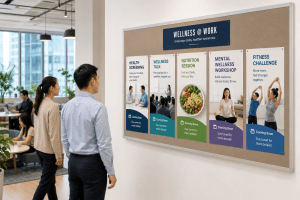
Compare company wellness solutions for employers, from health screening and wellness talks to mental, physical and financial wellbeing programmes, and learn how to choose the right mix for your workforce.
Company Wellness Solutions: An Employer’s Guide
Company wellness programmes can take many forms, from preventive health screening and mental wellness talks to fitness, nutrition and financial education. The challenge for employers is not finding wellness ideas. It is choosing the right combination for their workforce and turning separate activities into a programme that employees can actually use.
This guide focuses on how employers can compare different company wellness solutions, decide what belongs in their programme and build a balanced approach around employee needs, workplace realities and organisational priorities.
What Are Company Wellness Programmes?
Company wellness programmes are structured initiatives designed to support employees’ physical, mental and overall wellbeing. They may include health screening, wellness education, physical activity, mental wellness support, nutrition, financial wellness and workplace engagement activities. The most effective mix depends on the needs of the workforce rather than on a fixed list of activities.
The Main Types of Company Wellness Solutions
| Solution | Examples | Best Used For | Employer Consideration |
| Preventive health | Onsite screening, health assessments | Health awareness and preventive checks | Participant numbers, venue, lead time and registration |
| Health education | Onsite or virtual wellness talks | Giving employees practical knowledge | Topic relevance, speaker quality and attendance |
| Mental wellness | Stress, resilience, mindfulness programmes | Supporting mental wellbeing | Psychological safety, manager support and confidentiality |
| Physical wellness | Fitness sessions, yoga, movement challenges | Encouraging activity | Accessibility and different fitness levels |
| Nutrition wellness | Nutrition talks, healthy-eating education | Supporting healthier choices | Practicality and cultural relevance |
| Financial wellness | Budgeting, planning and financial education | Building financial awareness | Privacy, neutrality and different life stages |
| Social wellness | Group challenges and team activities | Connection and participation | Inclusivity and employee preferences |
How Should Employers Choose the Right Wellness Solutions?
Understand the workforce
Look at workforce demographics, work patterns, employee feedback and recurring wellbeing concerns. Office-based, shift-based and distributed teams may need very different delivery formats.
Define what the programme should achieve
Different objectives require different solutions. Preventive health awareness may point towards screening, while education and engagement may be better served by talks and workshops.
Prioritise accessibility
Consider whether employees can realistically attend. Onsite, virtual and hybrid formats each solve different accessibility problems.
Build a balanced mix
Avoid relying on only one dimension of wellbeing. A stronger programme may combine preventive health, mental wellness and educational topics over the year.
Check operational support
For HR teams, the provider’s ability to handle registration, scheduling, logistics and employee communications can strongly affect the experience.
Review cost and resources
Consider internal time, event space, available budget and the amount of coordination required. The lowest-cost activity is not always the easiest or most useful to implement.
Matching Solutions to Common Employer Needs
| Employer Need | Potential Wellness Solutions |
| Increase preventive health awareness | Onsite health screening + health education talk |
| Support stress and resilience | Mental wellness talk + manager education + ongoing support resources |
| Improve year-round engagement | Quarterly wellness calendar mixing talks, challenges and preventive health |
| Support employees across different locations | Virtual wellness talks + centrally coordinated resources |
| Address financial stress and planning | Financial wellness education + access to appropriate professional resources |
How to Avoid a One-Off Wellness Programme
A common mistake is treating wellness as a single annual event with no connection to the rest of the employee experience. Employers can create more continuity by planning several touchpoints across the year, using different formats and themes. For example, a preventive health screening can be followed by education around nutrition or lifestyle, while mental and financial wellness topics can be scheduled at other points in the year. The goal is to create a programme employees recognise as an ongoing part of workplace wellbeing.
How to Evaluate Company Wellness Providers
- Can the provider explain who the programme is suitable for and what operational requirements apply?
- Does the provider support registration, scheduling, employee communication and event coordination?
- Can the programme be adapted to workforce size, workplace format and employee needs?
- Does the provider offer credible subject-matter expertise for talks or healthcare delivery?
- Is there a clear process for collecting feedback and reviewing the programme afterwards?
How Corporate Health Screening Fits Into Company Wellness
Corporate health screening is one of the more practical preventive-health components within a wider company wellness strategy. It gives employees convenient access to selected health checks and can create a natural entry point for other wellbeing topics. Employers can combine screening with health education, nutrition, mental wellness or other programmes to create a more rounded approach rather than relying on screening alone.
Conclusion
There is no single company wellness programme that suits every organisation. Employers should compare solutions based on workforce needs, accessibility, programme objectives and the amount of support required to deliver them effectively. A balanced wellness strategy usually combines several areas of wellbeing and evolves over time based on employee participation and feedback.
FAQs
What are company wellness programmes?
They are structured initiatives that support employee physical, mental and overall wellbeing through activities such as screening, education, fitness and wellness support.
What should a company wellness programme include?
The mix depends on employee needs, but common areas include preventive health, mental wellness, physical activity, nutrition, financial wellness and health education.
How should employers choose wellness solutions?
Assess employee needs, define programme objectives, consider accessibility and operational requirements, then select solutions that fit those priorities.
How can employers encourage participation?
Choose relevant activities, make access convenient, communicate clearly and use employee feedback to refine future programmes.
How should wellness programme effectiveness be measured?
Review participation, employee feedback, satisfaction and progress against the stated objective of each initiative.
Need help choosing the right wellness mix for your organisation? Speak with ESG Wellness about onsite health screening, onsite talks and virtual wellness programmes.
Looking for ways to promote wellness in the workplace? Check out this article on how.