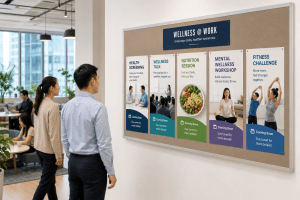
Choosing the right corporate wellness programme in Singapore can be challenging because every workforce has different health, wellbeing and participation needs.
For some companies, it may begin with an onsite health screening. Others may focus on mental wellbeing, financial wellness, resilience, or educational talks. The challenge for HR is not simply finding another activity to add to the calendar. It is choosing a corporate wellness programme in Singapore that employees will actually use and that the organisation can realistically sustain.
A good workplace wellness programme should balance employee needs, participation, operational requirements and measurable outcomes.
This checklist can help HR teams evaluate the options before committing to a programme.
1. Start With the Employee Need
Before selecting a vendor or format, start with a simple question:
What does our workforce actually need support with?
Corporate wellness programmes tend to work better when they respond to a genuine employee need rather than being selected simply because a particular activity is popular.
Depending on the organisation, priorities may include:
- Preventive health and early detection
- Mental wellbeing and stress management
- Financial wellbeing
- Resilience and workplace performance
- Healthy ageing
- Lifestyle and chronic disease awareness
Different workforce demographics may also require different approaches.
A younger workforce may be more interested in stress, financial wellbeing or performance. An older workforce may place greater value on preventive health, health screening and healthy ageing.
The objective should be to identify the areas where a wellness programme can create the most practical value for employees.
2. Choose the Right Wellness Format
Once the need is clear, HR can decide which format is most appropriate.
There is no single format that works for every company.
Onsite Health Screenings
An onsite health screening can make preventive health more accessible by bringing the screening directly to the workplace.
This can be useful when the objective is to encourage employees to better understand their current health status while reducing the inconvenience of travelling to an external clinic.
For HR teams considering health screening, participation and ease of registration are important. A screening programme only creates value if employees actually take part.
Onsite Wellness Talks
Onsite talks work well when companies want employees to participate together and create a more interactive experience.
Topics can cover areas such as:
- Mental wellness
- Financial wellness
- Preventive health
- Resilience
- Nutrition
- Workplace performance
The physical setting also creates opportunities for employees to ask questions and engage directly with speakers.
Virtual Wellness Talks
Virtual talks can be useful for organisations with hybrid, remote or geographically distributed teams.
They provide greater accessibility and can make it easier to offer wellness education regularly without requiring employees to be in the same location.
The right choice ultimately depends on the workforce, the topic and the desired outcome.
Many organisations may benefit from using a combination of these formats rather than relying on a single type of activity.
3. Make Participation Easy
A strong corporate wellness programme can still underperform if participation is difficult.
HR should consider the employee experience from the moment the programme is announced.
Ask:
- Is registration simple?
- Can employees understand what they are signing up for?
- Is the activity being held at a practical time?
- Is the location convenient?
- Is communication clear?
- Are employees reminded before the event?
Every additional step creates another opportunity for an employee to disengage.
For example, a workplace health screening may be relevant to an employee, but a complicated registration process or inconvenient timing can prevent them from participating.
Reducing friction is therefore an important part of increasing wellness participation.
4. Look at More Than Attendance
Attendance is useful, but it should not be the only measure of whether a workplace wellness programme worked.
HR teams can look at several levels of participation.
Registration
How many employees showed initial interest?
Attendance
How many of those employees actually participated?
Engagement
Did employees interact with the programme, ask questions, complete assessments or take relevant follow-up actions?
Employee Feedback
Did employees find the programme useful and relevant?
Follow-up Action
Did the programme encourage employees to take further action relating to their health or wellbeing?
Looking at these different stages gives HR a clearer picture than attendance alone.
A programme with large registration numbers but poor attendance may have a communication or scheduling issue. A programme with strong attendance but weak feedback may indicate that the topic or delivery needs to change.
The goal should be continuous improvement rather than simply recording that an event took place.
5. Consider the Operational Workload
Another factor that can easily be overlooked is the amount of work required from HR.
Running a wellness programme may involve:
- Employee communications
- Registration management
- Venue or virtual-platform coordination
- Vendor management
- Scheduling
- Employee reminders
- Event-day logistics
- Reporting
- Feedback collection
If every individual activity creates significant additional work for the HR team, maintaining a consistent wellness programme becomes difficult.
When evaluating corporate wellness services, it is therefore worth understanding how much of the operational process the provider can manage.
The easier the programme is to administer, the easier it becomes for HR to run wellness initiatives consistently rather than only occasionally.
6. Build a Programme Rather Than Isolated Events
One of the biggest opportunities for HR is to move away from treating wellness as a collection of unrelated activities.
A health screening, mental wellness talk and financial wellness session may appear to be completely separate initiatives.
But they can also form part of a wider employee wellbeing strategy.
For example:
- A health screening helps employees understand their current health status.
- Educational talks help employees understand relevant risks and behaviours.
- Mental or financial wellness programmes address other factors affecting employee wellbeing.
- Feedback and participation data help HR decide what to prioritise next.
Over time, this creates a more structured employee wellness programme in Singapore rather than a series of one-off events.
It also gives HR more information about which topics and formats employees respond to.
7. Review the Programme Regularly
Employee needs change.
A programme that works well one year may not have the same impact the following year.
HR should periodically review:
- Participation levels
- Employee feedback
- Popular topics
- Registration trends
- Workforce demographics
- Operational challenges
These insights can then guide the next phase of the programme.
This is particularly important for organisations running multiple wellness initiatives throughout the year.
Instead of asking, “What activity should we run next?”, the question becomes:
“Based on what we have learned, what does our workforce need next?”
That creates a much more deliberate approach to workplace wellness.
A Simple HR Checklist
Before selecting a corporate wellness programme in Singapore, ask:
- What employee need are we trying to address?
- Which format best suits that need?
- Is participation easy?
- How will employees hear about the programme?
- What will we measure?
- How much work will HR need to manage?
- Can the programme connect with other wellness initiatives?
- How will we use the results to improve the next programme?
If those questions can be answered clearly, HR is much more likely to build a programme that employees value and continue participating in.
Building a More Connected Workplace Wellness Programme
Corporate wellness does not need to be complicated.
The strongest programmes usually start with a clear employee need, make participation easy and use feedback to improve over time.
ESG Wellness supports organisations with workplace wellness formats including onsite health screenings, onsite wellness talks and virtual talks, allowing HR teams to combine different initiatives based on the needs of their workforce.
Explore ESG Wellness corporate wellness solutions and find the format that best fits your organisation.